
Information has become the most valuable asset of any company, but it is a coin with two different sides. It does not matter whether it is a multinational corporation or just a local startup. It is impossible to control the flow of information on your own. A brand's image online is shaped by countless users, search engine algorithms, and neural networks every second.
Reputation in the digital age
The concept of digital reputation is no longer just a marketing term. It has moved into the category of critical factors for national and corporate security. Publishing a press release in a major newspaper was enough to resolve an image crisis in the past, but today negativity spreads much faster. In our practice, we have seen cases where a single thread on Reddit crashed product sales by 30% in 4 hours, even before the PR department had time to draft an official response. Negativity wipes out a beautiful forest that grew for a century in a couple of hours.
The ability to send an anonymous opinion combined with the global audience of social media has created an environment in which a company's image can be destroyed overnight. A single comment from an angry customer brings down a brand's reputation. We have entered an era of radical transparency. Today it is impossible to hide systemic errors, and false accusations require a sophisticated response. If a brand does not have a plan to protect itself from these digital reputation threats, it becomes highly vulnerable in the public eye.
Principles of trust in the digital world
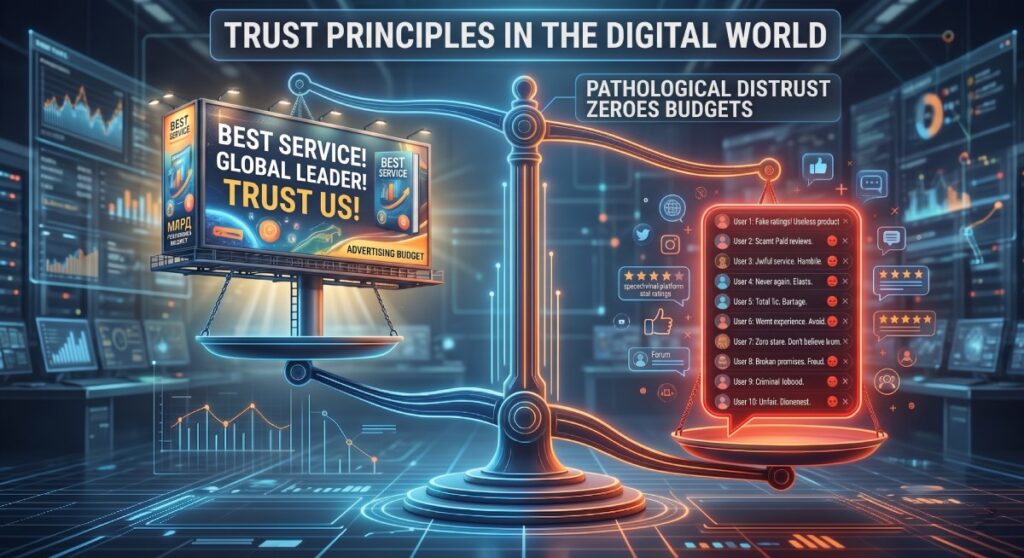
Consumers have become pathologically distrustful. Advertising budgets cost millions of dollars. They are negated by a few dozen angry reviews on the first page of Google. People do not believe slogans on billboards; they believe the digital footprint a company leaves behind. This footprint consists of:
- fragments of discussions on forums;
- expert columns;
- comments on social networks;
- ratings on specialized platforms.
Practical observation: a "sterile" profile without a single negative review in 2026 causes more suspicion among users than a profile with a 4.6 rating and adequately handled negativity. A lack of information is perceived as negatively as bad reviews.
Humans are social creatures, and in situations of uncertainty, they seek confirmation from those around them that their choice is right. In 2026, "those around them" are not neighbors on the landing, but aggregated data from the entire Internet. Creating a managed information bubble around a brand requires engaging top-tier experts. Such people have access to modern data monitoring and correction technologies. For example, a comprehensive service for building global trust in a brand, covering all aspects of its presence in the media and global network, is available here: https://buylink.pro/en/orm/.
Shaping brand perception in 2026
Reputation management is based on three pillars:
- monitoring;
- responding;
- proactive creation.
The mistake of executives lies in adopting a reactive approach. They only start thinking about reputation when sales begin to fall. When a user enters a company name in a search bar, the first results appear as links with headlines like "Terrible service" or "Scammers." Digital hygiene requires constant attention. It is similar to how the immune system works. When it is weak, any virus can paralyze the entire organism.
We have seen cases where a drop in Google rating by just 0.5 points (from 4.5 to 4.0) increased the cost of customer acquisition by 40% due to a decrease in conversion from search.
A modern reputation management specialist works across a wide spectrum:
- search engine results pages (SERP);
- aggregator platforms and rating services;
- social networks and communities;
- media and expert content;
- dark web and private forums.
Search results are the "storefront" of your business. The first page of Google is your main office. If it contains links to review sites with low ratings or negative media articles, the conversion rate approaches zero, regardless of how perfect the product actually is.
In 2026, stars and ratings became a full-fledged currency. Consumers make decisions in a split second by looking at the average score. If the rating is below 4.2, a potential customer will not click the link. In communities, reputation is dynamic. The tone of mentions in comments under posts or in relevant groups shapes the "emotional" side of the brand. Emotions are more important than facts here.
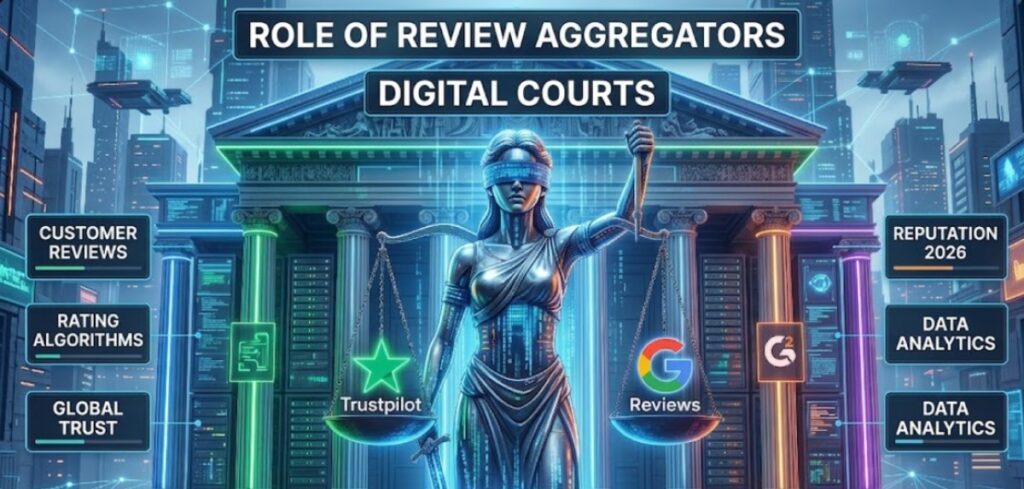
The role of review aggregators in the global decision-making cycle
Special attention should be paid to international platforms. They have power in the eyes of Google. It is important for companies to work with independent platforms. Search engine algorithms prioritize resources trusted by millions. It is practically impossible to overturn this priority. In Western markets, Trustpilot or G2 are "digital courts" whose decisions Google indexes with priority.
Working with global review platforms remains the main tool for international markets. These platforms allow for audits, the legal removal of unfounded negative reviews, and ensure the safe growth of your rating.
Without control over these communication nodes, a company risks losing up to 80% of its incoming organic traffic. People seek confirmation of the security of their transaction. If a company profile looks neglected or has been attacked by trolls, no discount will save the deal.
Psychology of negative feedback
A single complaint on social networks destroys a reputation that took years to build. This is due to cognitive biases in the human brain. We are programmed to pay attention to threats and negative signals. Psychologists call this "negativity bias." A bad review is perceived as a warning of danger, while a good one is seen as something paid for.
The modern digital environment encourages anger. Social media algorithms are designed so that angry posts receive significantly greater reach compared to neutral or positive news. An "echo chamber" of negativity is created. Yesterday's misunderstanding with a courier turns into a public outcry with hashtags and calls for a boycott.
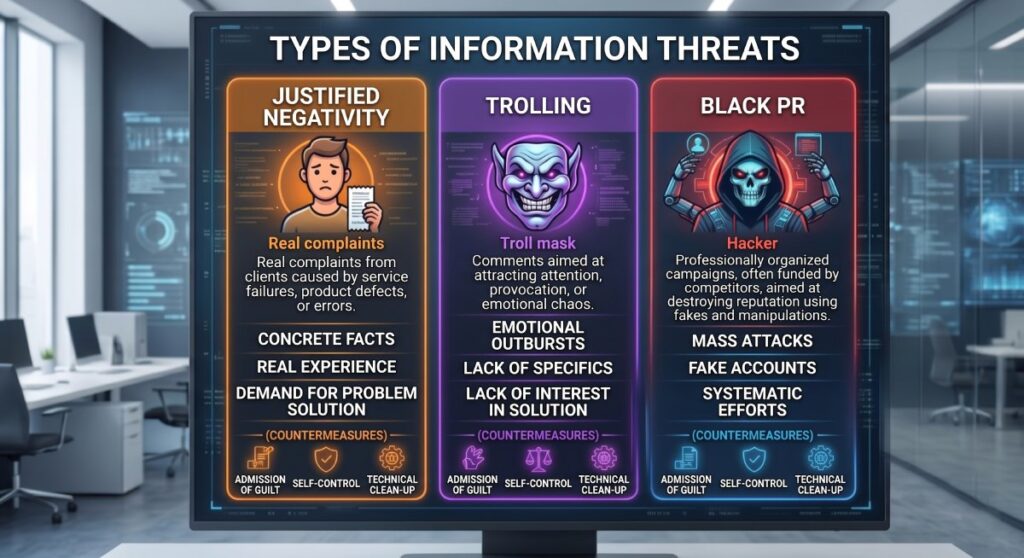
Types of information threats and countermeasures
There are three main types of online negativity:
- Justified negativity: Here, only an admission of guilt and public documentation of corrections helps.
- Trolling: Emotional outbursts that require stamina.
- Paid attacks (Black PR): Systematic efforts by competitors. We identify them by identical IP addresses, similar stylistic patterns, and an abnormal surge in activity during "non-working" hours.
These are systematic efforts, often funded by competitors, aimed at completely replacing positive search results with negative fakes.
To combat the latter, simply writing good posts is not enough. Technical work is required to clean up search results. If your top 10 Google results are filled with false information that cannot be removed through legitimate complaints, suppression methods come into play. You can order the suppression of harmful links and the capture of the first page of search results here: https://buylink.pro/en/serm/.
Analytics of mention data
The use of generative AI tools allows for the detection of anomalies. When the number of brand mentions increases by 500% within an hour, the system immediately warns you of the start of a disinformation campaign.
List of key metrics for reputation analysis:
- Net Sentiment Score (NSS) - a net sentiment indicator.
- Share of Voice (SOV) - the proportion of mentions of your brand compared to competitors.
- Reputation Score on key aggregators - changes in ratings over time.
- TOP-10 Visibility - the percentage of positive content on the first page.
- Customer LTV (Life Time Value) by reputation - how reviews affect the duration of the customer relationship.
Automation is only half the battle. Interpreting data and developing a response strategy require a deep understanding of context. Template responses only provoke further aggression. Integrating human empathy with powerful technological platforms is the only way to build a truly sustainable digital reputation. It is important to fully match typical behavior and average emotions. Express opinions in accordance with general perceptions. Simple, direct statements evoke the right emotions. This is how the world is built, so we must act accordingly. A holistic view and a human-centric approach can change the state of affairs in the digital world.
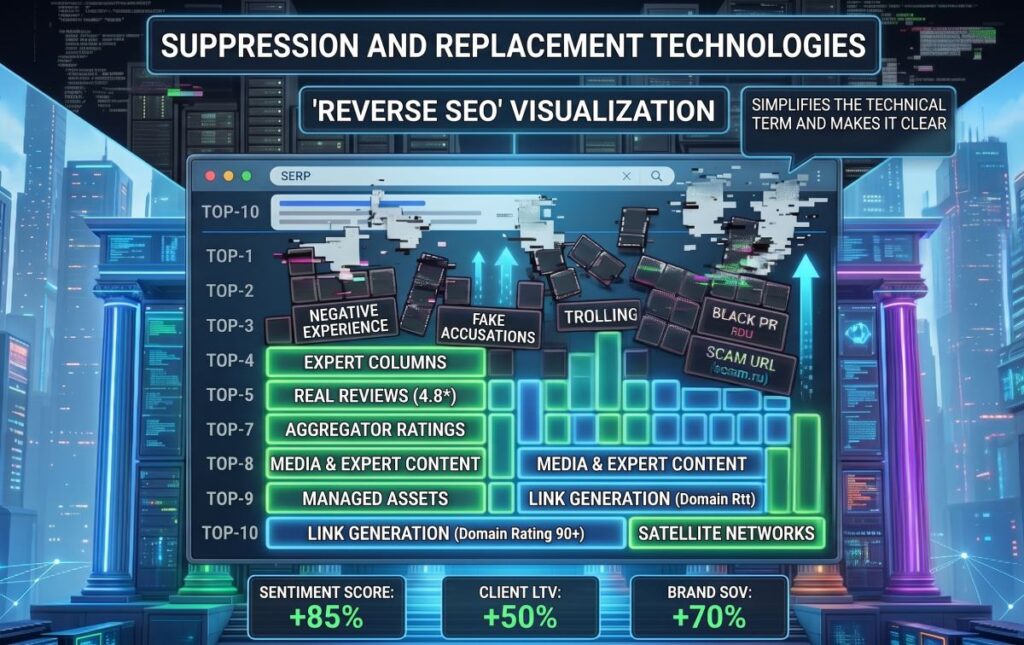
Suppression and replacement technologies
Let's shift our gaze from the psychology of perception to technical implementation. Radical changes in the structure of search results are necessary more often than not. Google search algorithms now determine the fates of businesses around the world. Professionals are those who move toward their intended goal and know how to deal with every obstacle before it arises. Waiting for a miracle is little better than surrender. The worst part is the inertia of search engines: as soon as negative content hits the top 3 results, it becomes much harder to remove it from the user's field of vision.
This cycle can be broken by creating authoritative and optimized information nodes. Otherwise, the network will infinitely interfere with the business. It is crucial to see the problem in time and start working on its solution.
The process of displacing destructive data is purely technical in nature and requires a high level of understanding; creating white noise from content is ineffective. You should build a multi-layered system of resources that will make people trust you, which means:
- generating high-priority links;
- optimizing social media profiles;
- creating satellite networks.
When faced with a professionally organized attack or long-standing digital baggage, "reverse SEO" methods should be applied. The strategy is aimed at pushing defamatory links beyond the view of the average user.
It is crucial to regain control over the first page of search results. This allows for a reset of the information landscape. "Burying" negative content by saturating the space with expert content is the optimal way forward; it naturally changes the information landscape. The work is not simple, so it should be entrusted to experienced professionals who know how to reset the online narrative at the lowest cost. Competent saturation of the information space with positive content makes it possible to push negativity into the background and build a base for future development.
Working with review platforms and social proof
Search results are the facade of a multi-story building. Ratings on aggregators perform this role. In 2026, we are witnessing the phenomenon of the "trust economy." Star ratings prevail over any advertising promises. According to the latest data, more than 90% of consumers read reviews before making a purchase.
Practice shows: companies that integrate a review request 15 minutes after receiving a product have a 60% higher rating, as they catch the customer at the peak of a positive emotion.
Global platforms with strict moderation occupy a special place in this ecosystem. The problem is that a satisfied customer rarely takes the time to write a review. A dissatisfied customer, on the other hand, is emotionally motivated. To correct this imbalance, a brand needs a proactive strategy for collecting feedback.
Creating a culture of feedback is an art. Successful companies integrate a review request into the purchasing process itself. The legal path to removal is slow these days. Technical reputation management is becoming the number one priority. Reputation is a fragile vessel that fills drop by drop over the years but shatters into pieces in a second. You must think about it constantly, starting from the very foundation of the platform, and never relax even at the peak of success.
Creating multi-layered defense
When speaking about digital reputation, we must understand its nuances. In the realities of 2026, this is not just a metaphor, but a technical reality. A brand becomes vulnerable when it is represented online as a scattered collection of pages. However, existence in the form of an ecosystem of interconnected, authoritative, and technically optimized nodes makes the brand resistant to external influences.
This type of defense implies that during a disinformation campaign, the blow does not fall on the company's reputation. The main impact is taken by a pre-created infrastructure. The information environment must be densely populated with managed assets so that negative content has no place to take root in search algorithms.
Global expansion and cross-platform trust
When entering international markets, the complexity of reputation management grows exponentially:
- cultural codes;
- linguistic features;
- legal norms.
All of the factors listed above create an environment in which standard methods stop working. What is considered the norm in one region can trigger a cancel culture in another. In such a situation, managing global platforms that serve as entry points for foreign investors and partners becomes critically important. You cannot simply have a good profile; you must demonstrate a consistent long-term trend of quality improvement. Auditing the current state, legally eliminating destructive factors, and building a system for the safe growth of ratings on key global platforms are tasks that require a meticulous approach. You can get expert support in managing your international image and building trust on a global level here: https://buylink.pro/en/trustpilot/.

Cybersecurity as the foundation of reputation
By 2026, the line between IT security and reputation management has blurred. Most recent major reputation disasters began not with poor service, but with data leaks or hacks of corporate accounts. A stolen customer database published online causes damage that cannot be fixed simply with good content.
Reputation management today includes:
- preventive monitoring of the dark web;
- protection of top managers (VVIP Reputation);
- combating deepfakes.
Detecting brand mentions on platforms where stolen data is traded. Personal accounts of executives often become the weak link. Discrediting them is the quickest way to cause a sharp drop in a company's market capitalization. Using AI to create fake videos or audio featuring senior management requires immediate verification and the removal of fakes from search results.
Algorithmic ethics and AI content management
Search engines do not just return a list of links; they generate a ready-made answer to the user's query. If a Google or Bing AI assistant, answering the question "Is it worth working with this company?", synthesizes a response based on old negative information, the deal will fall through before the client even lands on your site.
This has given rise to a new field: Reputation Engine Optimization. The specialist's task is to "feed" the neural networks the correct data so that their conclusions are complementary to the brand. This is achieved by publishing large volumes of structured data, white papers, and expert studies, which AI perceives as primary sources.
Social engineering and countering manipulation
They are the product of "troll factories" and black PR agencies. These organizations exploit vulnerabilities in the human psyche by launching viral hoaxes that appeal to basic emotions: fear, anger, or a sense of injustice.
Countering attacks of this type and scale requires technical knowledge and an understanding of social engineering mechanisms. It is important to be able to deconstruct a fake, expose its artificiality, and strip it of its emotional charge. However, if a lie has already been indexed and is at the top, explanations alone are not enough. It is necessary to physically suppress harmful resources in search results using powerful content saturation tools.
Review economics - from data collection to loyalty management
Reviews are no longer just text under a product. They represent a massive data set for analytics. Companies that know how to look for insights in feedback grow much faster than competitors. Analyzing the tone of thousands of messages allows for the identification of hidden product defects or shortcomings in staff performance before they turn into systemic problems.
Investors in 2026 look not only at EBITDA, but also at the dynamics of the Sentiment Score over the last 6 months.
The reputation management system must be integrated into all business processes:
- HR brand;
- investment attractiveness;
- customer service.
Creating a cohesive, transparent, and secure information landscape around your brand - one that works for you constantly - requires comprehensive solutions. These include both social media management and in-depth monitoring of mentions on all major global platforms. Reviews from former employees on Glassdoor or Indeed directly affect future hiring and attracting talent. Investors analyze the information landscape just as thoroughly as they do financial reports. The speed and quality of your response to negativity in the public sphere is the best advertisement of your customer-centricity.

The price of silence in a digital world
Ignoring your online image is like leaving your front door wide open in a bad neighborhood, hoping for the best. Some managers think that if they do their job well, the internet will eventually notice and reward them. This is a dangerous fairy tale. In reality, the digital space naturally tilts toward chaos. If you do not fill the void with your own story, your competitors or a few angry voices will do it for you.
Nature abhors a vacuum, and search engines hate empty profiles even more. When official or positive data cannot be found, algorithms grab whatever is available. It could be a three-year-old complaint from a person who just had a bad day. You can spend any amount on a new office and a fancy logo, but if search results are filled with a list of unanswered questions and criticism, your investment is burning away.
Psychology of the digital society
People always try to follow the pack. It is a survival instinct thousands of years old that has migrated from the forest to the screens of digital devices. When a user sees a long list of negative comments, their brain sends a high-alert signal. They do not look for logic or proof; instead, they just feel unease or, even worse, want to write a similar review, even if they have never come into contact with your product before. This emotional reaction is much stronger than any rational argument you might present in a boring press release.
To win this battle, you must speak the language of the crowd. This means using social proof as a shield and a sword. You need to gather a chorus of real, happy voices that can drown out the noise of a few haters. It is not about lying; it is about making sure the truth sounds loud enough to be heard. A brand surrounded by a community looks like a leader.

Long-term support and the human factor
Even the best automated systems cannot replace human intuition. Algorithms can find a problem, but they do not always know how to heal a broken heart or calm an angry customer. You must remain human in a world of bots. People can smell a template response from a mile away, and it makes them even angrier.
Real reputation management is a marathon, not a sprint. You have to check the "temperature" of the internet every single day. One small shift in the public mood can change everything. Being prepared means having a team that knows when to fight and when to listen. Today, success belongs to those who treat their digital image as a living organism that needs constant care, food, and protection. If you stop paying attention to your garden, sooner or later the weeds will always come back to take over your little paradise.