
The modern world has entered an exciting era known as the digital economy. Stores have moved from shopping malls and bazaars to the World Wide Web. To run a profitable business, you need to have an impeccable reputation. Indeed, any business depends on image. Nowadays, simply praising your brand and exalting it is no longer enough. Users have learned to defend their rights and share information with each other.
Google search offers a lot of content about any brand. Often it has a negative connotation. One caustic review, an old lawsuit, or a commissioned article can cost a company millions. Our experience shows: the presence of negative material in the TOP-3 search results reduces trust in the brand by 40-60% even before the user goes to your site. Lost profit is a leak of family or corporate finances. This situation often ends in a career collapse. Modern digital tools help clean up search results and increase the company's chances of a successful business by improving the ranking.
What is SERM?
Search Engine Reputation Management is the process of monitoring a company's reputation in search engines. Simply put, this is a set of measures aimed at combating negative reviews about a company. How often does a businessman go online and read information about himself left by others? It happens. Career and sales depend exclusively on reputation management. If an entrepreneur is not interested in what clients say about him or what reviews they leave after working with him, then the collapse of the company is just around the corner. In the end, partnerships with users and review authors are the key to a stable business.
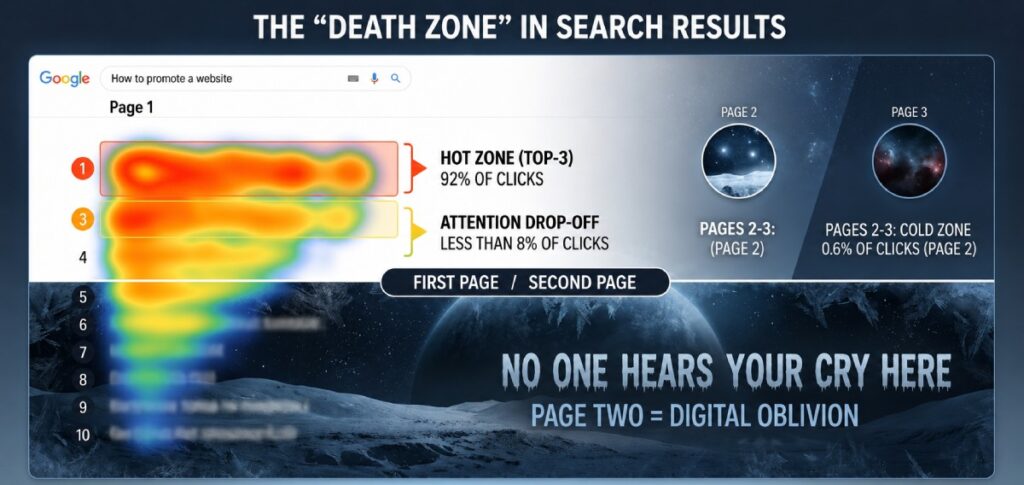
It is enough for users to go to the first page and see all the necessary information about the company and its owner. 2026 statistics confirm: 92% of clicks stop on the first page. Only 10% of users go to the second page. Almost no one goes to the third. Statistics show that if a user sees a negative comment about a company or brand of interest to him, his trust drops sharply. If there is no confidence in the reliability of the organization, no one will want to deal with this company.
Doing business, it is difficult to please all clients. Entrepreneurship is a complex and thorny path where positive and negative content intertwine. The more negative comments a brand receives, the harder it is to break out of the whirlpool of negativity.
Experience shows that it can take months to remove unflattering comments from the first page. What is difficult about removing negative comments? Most review sites adhere to this policy to avoid undermining trust, primarily from users. If giants like Google or Trustpilot start removing all unflattering comments, the value of the platform will drop sharply.
These sites are arbitrators. If a bad review does not violate the site's rules, it remains. The site moderator will not judge a dispute between a company and a client. The store says: "We have never had such a user". The user, in turn, defends his position: "I was there, just threw away the receipt".
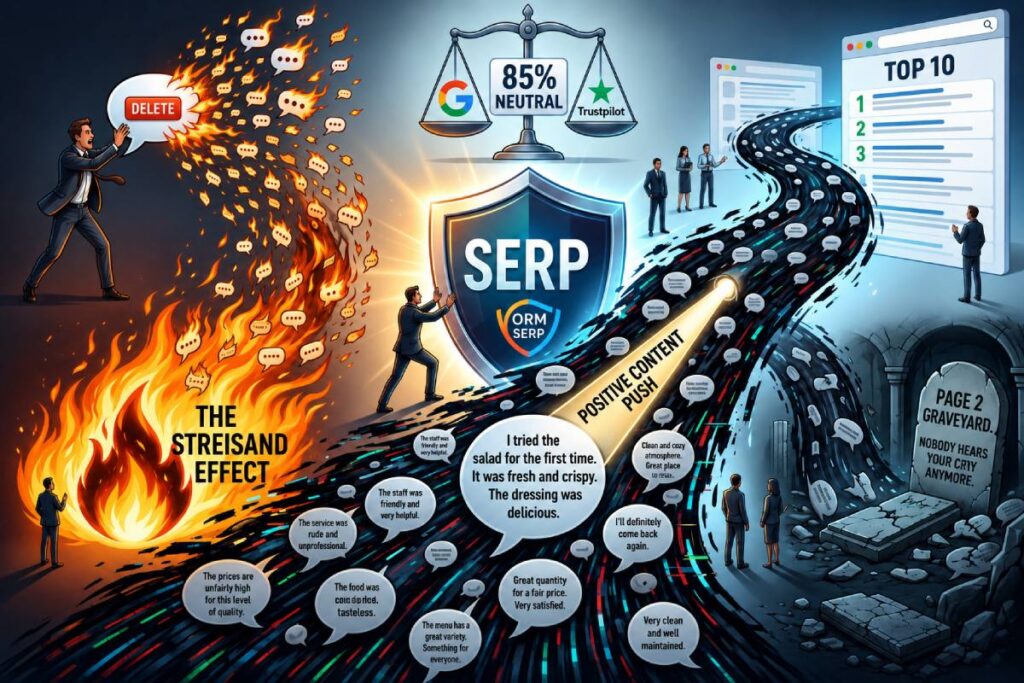
How will Google or Trustpilot resolve this situation?
In 85% of cases, they will take a neutral position. Legal difficulties are also worth noting. They stem from the fact that unflattering comments represent a value judgment. For example, a client writes: "I didn't like the salad at all. It smells like garlic. Its taste is disgusting. I will never eat in this restaurant with its terrible food again". How should the law act in such a case? A value judgment is a personal matter. In most cases, no one will be punished for this. The law will take a neutral position.
Deleting comments does not solve the main problem. Experts point to the Streisand effect. If a company tries to delete a negative comment, then the user, seeing the absence of his own review, resorts to aggressive actions. He can publish a story with a detailed description of how the company is trying to whitewash its reputation and silence the user. The Streisand effect will lead to even greater damage to the company's image.
The main goal of SERM is not just to remove negative search results. No! The service is designed to push negative links off the first page. As practical observations and statistical reports show, the second page interests practically no one. Users will read the top "page".
Practical aspects
To suppress and remove negative comments, they must be analyzed. Depending on the type of content, "corrective measures" are selected:
- Validity assessment: The reputation management service evaluates the reality of the experience on platforms like Google and Trustpilot.
- Check for Black PR: Competitors often resort to slander. We calculate such attacks by technical patterns: identical IP addresses, the use of text templates, and anomalous surges in activity during non-working hours. A copywriter writes a paid article, the user reads it, and sales drop.
- Analysis of old data: SERM checks court cases, old reports, and fines.
- Personal data protection: In comments, it is important to pay attention to home addresses and phone numbers. Black PR agents often indicate false data. Posting personal data of employees is one of the few 100% levers that allow legally demanding the removal of a link directly from Google.
After the assessment, which is carried out using https://buylink.pro/en/orm/ , one can proceed to the search for solutions. The search for solutions has a comprehensive nature. The most reliable method is considered to be removing the link from the search engine index. The second method is to ask/force the user to delete the negative comment. Independent discussion of this issue can lead to a dead end. To achieve a guaranteed result, it is necessary to consult with professionals. ORM specialists can not only legally influence the owner of a site with a negative review. They conduct deep expert research on all digital platforms where negative information about the company can be posted.
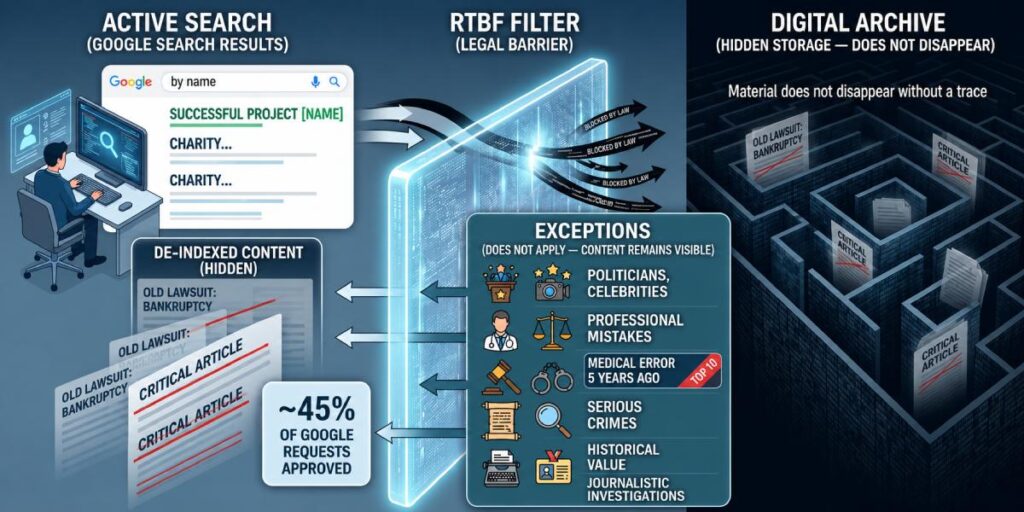
What is the right to be forgotten?
In many developed countries of Europe and America, there is a legal loophole. This is a unique concept allowing anyone to demand the removal of information from the internet. This request is appropriate if the content is outdated. Search engines can also be cleared of inaccurate and harmful information. It is important to understand a simple truth: material does not disappear without a trace. Simply, when entering the full name of a person or the name of a company, negative information will no longer be displayed in the search results. Often, knowledge of this law can help clear a reputation. In practice, in 2026, we see that Google approves about 45% of requests under this procedure if it is proven that the information causes "excessive harm" to private life without public benefit.
It is important to understand: the material does not disappear from the source site, it simply stops being indexed by the person's name or brand query.
The right to be forgotten does not apply in the following cases:
- Information important to society will not be deleted by Google and other review sites. Companies will simply be refused if their owners are political figures, celebrities, or famous businessmen. Their current status directly depends on their past life, so you simply cannot delete the content.
- The World Wide Web will not forget the professional mistakes of doctors, lawyers, and architects. Search engine algorithms are configured in such a way that this information is important for the safety of potential clients. With its help, users can independently assess the risks of doing business with the company. In our cases, we have encountered the fact that even after 5 years, reviews about a medical error remain in the TOP-10, and here only the suppression method helps, not deletion.
- Google and other review sites will never delete publications about serious crimes (corruption, fraud, violence), especially in cases of unexpunged or unremoved convictions.
- The World Wide Web is not cleared of materials having historical or scientific value. These include newspaper archives that were digitized in media archives.
- The law may require the preservation of data in the register of debtors and the register of court decisions.
- Search engine algorithms are designed to prevent the removal of materials damaging freedom of speech and the press. The law protects investigative journalism data based on facts of public interest. It remains to note that the right to be forgotten is exercised only by a few.
The use of services like https://buylink.pro/en/serm/ allows a competent approach to solving the important issue of a company's image. Professionals will always find a solution to a complex issue.
Content removal strategy through providers
Search algorithms act as providers. Not all information can be physically deleted. The SERM service helps suppress negative links in Google search results and similar systems. In what cases does Google allow content removal? There are three reasons for removing negativity from the World Wide Web:
- If the material contains confidential information, for example, bank card numbers or medical records.
- The comment violates copyright in accordance with the DMCA.
- The third reason is outdated content.
Another life hack for those who managed to delete a negative comment. The page can be cleared, but still appear in the search results. In this case, it is best to use a digital tool called Google Search Console. It clears the cache. We often use the "Remove outdated content" tool, which forces the Google bot to re-index the page in 24-48 hours, otherwise a "phantom" link with a negative description can hang in the search results for weeks.

SEO suppression or removal
When negative comments cannot be deleted legally, digital assistants begin to push the information to the second page of search. If 90% of users do not read negative comments on distant pages, they become potential clients of the company. To remove one negative link, it is necessary to create a defensive perimeter. It consists of 10-15 authoritative resources. Below is a detailed guide to creating a defensive perimeter:
- Satellites and the main site. Analyze the content of the main site. Optimize the information (add new, delete outdated). Create satellite sites. These are auxiliary web resources. With their help, you will be able to promote your main project, for example, a personal brand, and the key page of the site. This is a kind of support group. It will help you displace two factors: competing pages and negative content. Your link will not be the only one in the top results. It will be surrounded by a support group of satellite sites, which will lead to the appearance of several positions in the top ten. Auxiliary platforms will surpass a poorly written article about the company and send it to the second page of Google search. Satellites give "weight" to the main site and increase search rankings. They also attract the necessary additional traffic. Working moment: we select domains for satellites with a DR (Domain Rating) above 40 so that they can quickly "outweigh" a negative post on a weak forum.
- Social networks. For additional ranking, it is necessary to create profiles in popular social networks. These include LinkedIn, Twitter, and Facebook. Why register on social networks? The answer is simple. They have the greatest authority and attract the most traffic. Organization profiles and personal pages reach the top three. Social networks such as Facebook and Instagram are ideal for distributing expert content and official news. These platforms allow creating a competitive product that will earn additional links in search results. According to our data, a LinkedIn profile is indexed by Google in the TOP-5 for a brand query within the first 48 hours after creation.
- Google Business and directories. Register your company in Google Business and professional directories. This is a basic, effective SERM tool. The company's main site can be called a digital fortress. The created profiles in professional directories and Google Business will serve as its outer walls. They will be the main recipients of search queries. Registration on these platforms creates a right sidebar. Thus, your company will control from 30 to 50% of the digital space on the first page. This is critically important: the Knowledge Panel on the right dominates visually so much that the user may not even look at the main search list if there is a high rating there. Users will see photos of your company, opening hours, address, and contact information. Professional directories have high domain authority. Links to your organization from these resources will instantly appear in the top ten Google results. Simple digital math says that the more complete profiles on verified platforms, the fewer negative reviews and articles with questionable data. Another important function of "yellow pages", specialized resources, and Google Business is the collection of reviews. A user enters the query "buy a brand" and immediately sees the number of stars. On an intuitive level, this increases trust in you, which will outweigh negative comments on other online platforms.
- Heavy artillery (PR). Publishing articles on popular verified platforms is considered heavy artillery. In professional circles, this process is called PR promotion or outdoor marketing. A link to the site in publications such as Forbes, RBC, VC.ru, Hubr, Medium, and Cnews demonstrates the authority of the company in the eyes of Google. A publication on these portals will immediately move to the first page of Google. This process takes only a couple of days. The high authority of the platform equals minus a few questionable comments. Yes, platforms like Forbes, RBC, VC.ru, Hubr, Medium, and Cnews are an unspoken force in the digital world. Users always strive to verify the reliability of a company. On popular business portals, they will see the company's expertise and read interviews with leading specialists. A popular platform will have more weight than an article in a shabby magazine like "Mom's Weekdays". In one of our cases, an article on Medium pushed a negative review from the TOP-3 to the 14th position in just a week thanks to the huge Domain Authority of the resource. Publications on authoritative platforms can include a link to the store's site. Google perceives this link as a powerful trust signal. The growing rankings of an online portal imply high resistance to cyberattacks and smear campaigns.
Tone management
There are a few more ways to increase your ranking. Learn to manage your tone on the net. If a competitor publishes an article about your brand with the headline "Company K: Scammers", write an article with the headline "Methods of combating fraud by Company K". This leads to the following conclusions:
- You will be able to intercept traffic from negative queries.
- The user will hear the version of events from your company.
These actions will help improve your reputation and increase your ranking in a specific niche. What this looks like in practice is shown in our SERM case study on the “double strike” effect.

What is the role of ratings and reviews on Trustpilot?
Entrepreneurship is impossible without a good reputation, to which users can gain access on specialized virtual platforms. Trustpilot - is one of them. It is considered the most influential review platform. A couple of negative ratings on this platform, and your company's sales will drop sharply. An effective solution would be to use the services of https://buylink.pro/en/trustpilot/ . This service will help minimize criticism and restore trusting relationships with clients. Experts recommend observing three rules for interacting with clients on Trustpilot and local review sites:
- Communicate with clients and encourage them to leave positive reviews. An additional 5% discount on certain goods and free shipping for a good review is a small price for your reputation.
- A negative comment should not be left without attention. Communicate with your client base, especially dissatisfied ones. Entrust professionals with a constructive response to negative comments.
- If there are malicious reviews, request moderation from the platform. Yes, you can report spam and clear your reputation.
Ratings on Trustpilot are accrued as follows:
- Recently published comments have a greater impact on the star rating than reviews written a year or two ago. This is the Recency phenomenon: Google in 2026 prioritizes reviews over the last 3-6 months when forming a snippet.
- It is best to write comments systematically, without rushing. We have recorded that an influx of more than 15 reviews per hour to a new profile triggers an automatic "suspected fraud" mark from the Trustpilot protection system. If a company receives a huge number of reviews in a short period of time, the platform will perceive this as fraudulent behavior. Fraudulent activity will not improve the platform's reputation, but, on the contrary, significantly lower it.
The system works as follows: if 3-4 user comments are posted on the platform, its rating is equal to the average. As soon as there is enough data to determine the number of stars, the final rating will be determined. The reputation management service works competently and carefully with leading review authors. No one will demand the deletion of reviews. Everything starts with the normalization of relations with clients. Every negative review must be accompanied by a public response from the company.
The publication must be polite and professional. The client may be wrong, but it is important to remember that the response will be read by thousands of potential buyers. Establishing mutual understanding is half the battle in the fight against negativity.

Analysis and cleaning: Second stage
The second stage of working with the service involves a detailed analysis of reviews containing the following nuances:
- The comment contains obscene language.
- Personal information of employees is disclosed in the post.
- The information contains a large amount of spam and promotional offers.
- The affected company has evidence that the review was written by an unrelated user who did not work with the online store. In our practice, we often find a "digital footprint" of commissioned attacks: when 5 negative reviews come from the same pool of IP addresses or contain the same grammatical errors.
Comments containing the above content can be disputed. Before contacting a moderator, it is necessary to collect all links from the top twenty search results. Take a screenshot of the materials. This will come in handy in the event of a legal proceeding. Then you can try to remove the content through the review site administrators. It is recommended to use DMCA-style forms to submit complaints. Do not forget about the right to be forgotten. At the same time, start working on positive content. Just don't dump a huge number of positive posts onto the internet overnight. No. The process of polishing your image and improving your reputation takes a long time.
At the same time, remember that removing negative content from the internet should not be a one-time event. Companies fighting for their survival in the market need to prepare for a marathon. In simple cases, two weeks are enough to clear a reputation. Complex situations require systematic, multi-month work. Experts emphasize that clean search results are an asset of the company. It can be compared to intellectual property or specialized equipment. Do not wait until the popularity of the business goes into decline or competitors become more active. It is better to contact reputation management services in advance. Working with reliable partners will help prevent undesirable situations and maintain leading positions. It is better to take care of your ratings in advance than to lose profit and face a long recovery period.
FAQ
Can negative search results actually be removed from Google?
Only in specific situations: the content violates the platform's rules, it falls under Google's removal policies (exposed personal data, explicit imagery, copyright), or the site owner agrees to take it down. Everything else is handled through suppression: strengthening the pages you want people to see until the negative one loses visibility.
How long does it take to push a negative result down?
A weak forum post can leave the top 10 in 2-3 months. An authoritative news article, a Trustpilot profile or a Reddit thread can take 4-8 months of continuous work. Anyone promising days is describing something that will not last.
What does this work cost?
A deep audit with a suppression plan costs $300-1,000; hands-on campaigns run from roughly $1,000-1,500 per month for one problem and more for several markets. We break the ranges down in our guide to online reputation management cost in 2026.