A bad Trustpilot review is read by far more people than the person who wrote it. Prospects scan negative reviews first, and what they actually judge is not the complaint itself but your answer under it. A calm, specific reply turns a one-star review into proof that your company handles problems; silence or a defensive rant turns it into proof of the opposite. This guide gives you a simple response framework and copy-paste templates for the most common scenarios, based on the review work we do at Buylink.pro.
The 4-step response framework
Every good reply to a negative review does four things, in this order:
- Acknowledge fast and by name. Reply within 24-48 hours, address the reviewer by name, and name their specific problem. A reply that could be pasted under any review reads as a bot.
- Own what is yours, factually. If something went wrong on your side, say so in one sentence, without excuses and without a lawyer's tone. If the facts are wrong, correct them politely with specifics, not with accusations.
- Move the resolution offline. Give a direct channel: a named person, an email, a ticket number. The public thread is not the place to process refunds or debug accounts.
- Close the loop publicly. When the issue is resolved, add a short update under the review. Future readers should see the ending, not just the conflict.
Keep replies to 3-6 sentences. Long apologies read as guilt; long rebuttals read as defensiveness. And never copy-paste one template into every thread verbatim: adapt the specifics or readers will notice the pattern faster than you think.
Templates by scenario
1. Genuine service failure
Hi [Name], thank you for flagging this, and I am sorry we let you down on [specific issue]. This is not the standard we hold ourselves to. I have passed your case to [person/role], who will contact you at the email on your order within 24 hours to make it right. If that does not happen, reach me directly at [email]. - [Name], [role]
2. The facts are wrong, politely
Hi [Name], thanks for taking the time to write. I want to clarify the timeline for other readers: our records show [specific fact: the order shipped on X / the refund was issued on Y]. If something looks different on your side, please email [email] with your order number and we will sort it out the same day. - [Name], [role]
3. Angry, emotional review with a real problem inside
Hi [Name], I hear the frustration, and honestly, in your place I would be frustrated too. The core issue - [restate the problem in one neutral sentence] - is fixable, and I would like us to fix it this week. [Person] will reach out today; if you prefer, write directly to [email] and mention this review. - [Name], [role]
4. You suspect the review is fake or from a competitor
Hi, we take every review seriously, but we cannot match this one to any customer record: no order, email or ticket matches the details described. If you are a real customer, please contact [email] and we will resolve your case immediately. Otherwise we have asked Trustpilot to verify this review.
Post the reply first, then flag the review through Trustpilot's reporting flow. The public answer matters even if the review is eventually removed, because readers see it while the check is pending. Never accuse the reviewer of lying in the reply: if the review turns out genuine, that answer will haunt the profile.
5. The issue was already resolved offline
Hi [Name], thank you again for your patience while we sorted this out. For anyone reading: the issue was [short description] and was resolved on [date] with [outcome]. If anything else comes up, you know where to find me: [email]. - [Name], [role]
6. Old negative review that no longer reflects your service
Hi [Name], this review describes a real problem we had in [year]. Since then we have [one concrete change: rebuilt support, replaced the provider, changed the policy]. I cannot change your past experience, but if you ever give us another chance, I would like to show you the difference personally: [email]. - [Name], [role]
What not to do
- Do not argue in threads. One reply, one update after resolution. Back-and-forth exchanges always read as losing, whoever is right.
- Do not offer compensation publicly. "We will refund you" under a one-star review trains readers to expect refunds for one-star reviews. Move it offline.
- Do not use legal threats in replies. Even when justified, they belong in a letter, not under a review where prospects read them.
- Do not buy positive reviews to bury the negative one. Platform filters catch bulk patterns, and a flagged profile is a far bigger problem than one bad review. Real review velocity from real customers is the only sustainable answer; that process is exactly what a Trustpilot management service builds.
When a reply is not enough
A single negative review with a good response is healthy: profiles with a flawless 5.0 and no criticism look less credible to readers than a 4.6 with visible, well-handled problems. But if negative reviews dominate the first screen of your profile, if your TrustScore is dragging conversion down, or if the review page ranks in your branded search results with a low score visible in the snippet, you are past the point where replies alone fix it. That calls for systematic work: review velocity, profile optimization and often SERM for the branded SERP. See how that looks in practice in our Trustpilot case studies with real numbers.
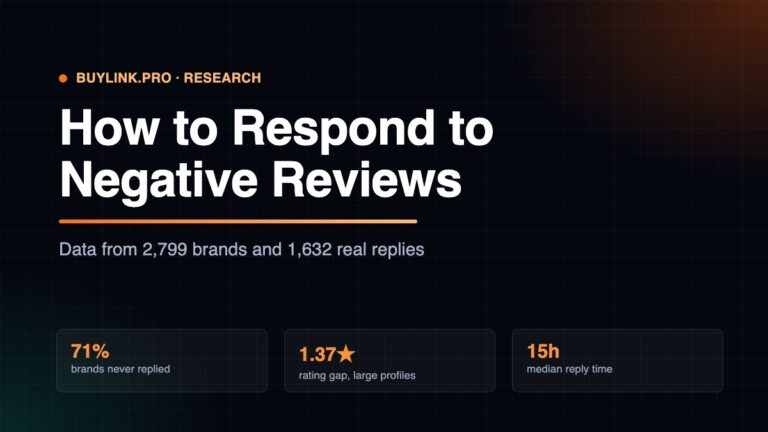
We analysed 1,632 real company replies: see the data.
FAQ
Should I respond to every negative review?
Yes. An unanswered negative review reads as confirmation. Even a suspected fake deserves a public reply for the readers, followed by a report to Trustpilot.
How fast should I reply?
Within 24-48 hours. Speed itself is a trust signal: readers see the response date next to the review date.
Can I get a negative Trustpilot review removed?
Only Trustpilot decides removals, and only for rule violations: fake identity, conflicts of interest, prohibited content. You can flag a review with evidence, but justified criticism stays, so the reply under it is your real lever.
Who should write the responses: support or marketing?
Whoever can resolve the issue should own the channel, usually support, with marketing setting the tone guide. What matters is one accountable owner, a response SLA and sign-off rules for sensitive cases.
Drowning in reviews you do not have time to answer? We run response management as part of the Trustpilot reputation service: tone guide, SLA, escalation rules and honest reporting. The first audit of your profile is free.