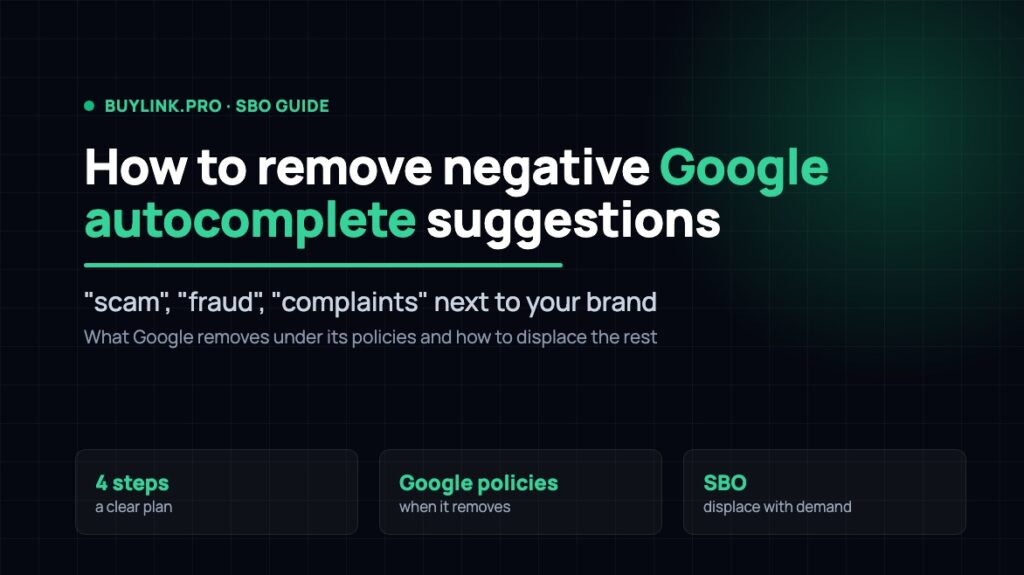
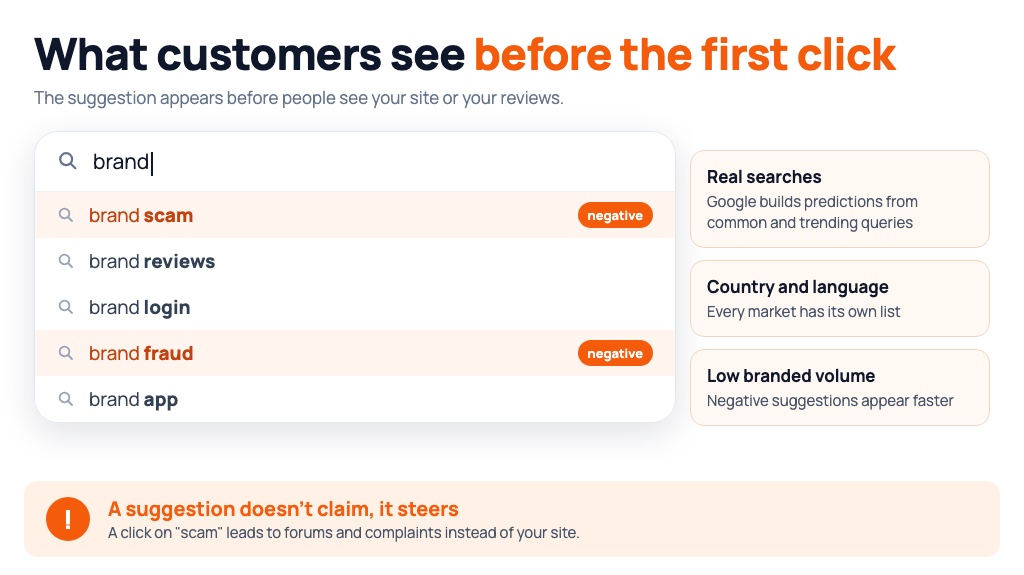
Someone hears about your company, opens Google and starts typing the name. Before they press Enter, the box suggests "brand scam", "brand fraud" or "brand complaints withdrawal".
They haven't read a single review yet, but the question is already on the screen. And Google asked it.
For fintech, iGaming, crypto, online education and subscription SaaS this is a direct loss. Some people click the suggestion, land on forums and complaint threads, and never come back.
There is no "remove this prediction" button for businesses. That doesn't mean nothing can be done. In a few narrow cases Google removes a prediction under its own policies, and in every other case there is a reliable way to push it out of the list.
Below: where these suggestions come from, what can be removed, what has to be displaced, and how long it takes.
Where negative suggestions come from
Autocomplete is built from real searches. According to Google, the system shows common and trending queries that match what a person starts typing. The list depends on language and location, and when interest in a topic spikes, Google may show a trending prediction even before it becomes common.
The key takeaway: "brand scam" appears because people really search for it. The usual reasons:
- Checking before paying. In niches where customers send money upfront, many people habitually search "name + scam" or "is name legit". It doesn't always mean there are complaints.
- A wave of negativity. Delayed payouts, an outage, a controversial email, a news story or a Reddit thread. People go to Google to check the rumor.
- A similar name. Another brand with a similar name earned the "scam", and the suggestion lands on yours.
- Low branded search volume. If few people search your brand, a few dozen identical queries a week are already visible to the algorithm. That's why young and niche companies get negative suggestions faster.
The last point works both ways. The lower your branded demand, the easier a suggestion appears, and the easier it is to displace.
Why a negative suggestion hurts
A suggestion doesn't claim anything by itself. But it changes the person's path.
They wanted your website and clicked "brand scam" instead. Now they see forums, complaints, Reddit discussions and reviews instead of your homepage. A branded search turns into a rumor check.
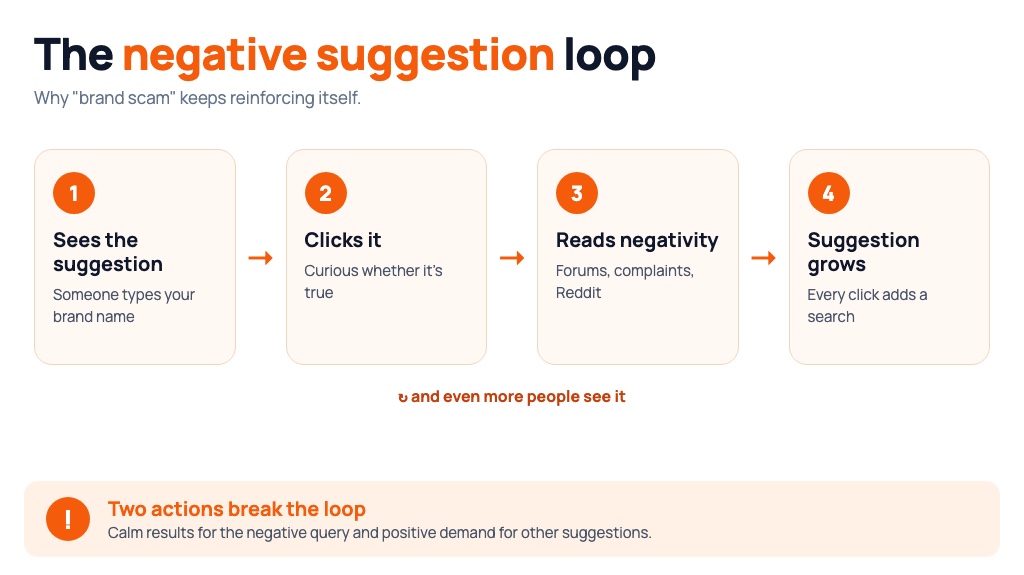
Then the loop starts. Every click strengthens the query, the query strengthens the suggestion, and more people see it.
There is a second layer. Results for "brand scam" and "brand reviews" are read not only by people. Google AI Overviews and ChatGPT use them too. If those results are negative, the negativity ends up in AI answers. More on that in why your brand is not in ChatGPT.
Step 1. See exactly what people see
Suggestions differ by country, language and device. So you need the full picture, not one screenshot from your laptop.
- Open Google in an incognito window so your own history doesn't affect the list.
- Check every country and language where you have customers. Use a VPN or an autocomplete checking tool for other locations.
- Type the name, the name with a space, and then the name with first letters: "brand s", "brand f", "brand l". Negative suggestions often hide in the second row.
- Check common misspellings and alternative spellings.
- Look at mobile and the Google app.
- Check YouTube and Bing if they bring meaningful traffic.
Save dated screenshots. You'll need them to track progress.
Most importantly, click every negative suggestion and look at the results page. Sometimes the suggestion is unpleasant but the results are calm. Sometimes it's the opposite, and then the real problem is the results, not the suggestion.
Step 2. Check whether Google will remove it under its policies
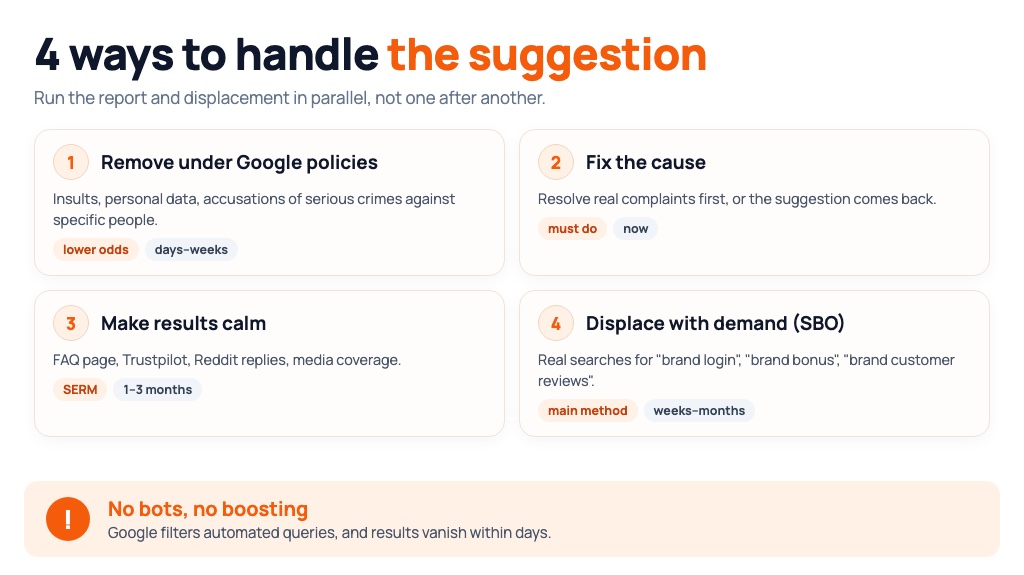
Google has autocomplete policies. Automated systems filter out many unsuitable predictions, and anything that slips through can be reported.
Predictions with dangerous, harassing, hateful, sexually explicit, violent or vulgar content qualify for removal. Google also removes predictions that associate a named individual with disparaging or sensitive terms, and predictions that read as accusations of serious malevolent acts against individuals or groups without well-established evidence.
An honest assessment: "brand scam" about a company usually doesn't fall under these rules. For Google it's a common user question, not an insult. Your chances are much better if:
- the suggestion contains the owner's or an employee's full name next to an insulting word;
- it contains profanity or a direct threat;
- it accuses the company or a person of a serious crime that never happened;
- it contains personal data.
How to report:
- On desktop: below the list of predictions there is a "Report inappropriate predictions" link. Select the prediction and the reason.
- In the Google app on Android: touch and hold the prediction, then choose "Report".
- Legal route: if a prediction violates the law, there is a legal removal request form. Google itself warns that it will look at your request but might not remove the prediction.
Google doesn't state response times and doesn't guarantee removal. Report it, but don't build the whole plan around the report.
Step 3. Fix the cause and answer the question
If real complaints are behind the suggestion, start there. You can push a suggestion out, but as long as people keep writing "can't withdraw money", it will come back.
The second step is to answer the question itself. The suggestion may stay in the list for a while, but what matters more is what a person sees after clicking it. You need pages that calmly and factually answer "is brand a scam":
- a page on your site that addresses common doubts: licenses, company details, payout times, how disputes are resolved;
- a Trustpilot profile with replies to reviews. There is a separate guide on handling negativity there: how to remove negative reviews on Trustpilot;
- company replies on Reddit and forums where the discussion is already happening;
- coverage in media and industry publications.
The goal is to make the results for the negative query neutral or positive. The systematic approach is covered in how to push down negative search results on Google.
Step 4. Push the negative out with positive demand
The dropdown has a limited number of slots. When other branded queries grow, they take the top rows, and "scam" slides down and then disappears.
This is what search box optimization (SBO) does. The idea is to create real demand for useful branded queries:
- "brand login", "brand app", "brand dashboard";
- "brand pricing", "brand promo code", "brand bonus";
- "brand customer reviews", "brand license";
- "brand + your core service".
Where that demand comes from:
- Owned channels. Emails, push notifications, chatbots and social posts that ask people to search a specific phrase, for example "brand bonus 2026".
- Ads and offline. Banners and mentions that invite people to search a phrase instead of clicking a link.
- PR and publications. Articles after which people search the brand together with the right word.
- Crowd marketing and communities. Mentions in discussions that lead to branded searches.
One important detail: work in the countries and languages where the negative suggestion appears. Suggestions in the US and the UK live separately.
What not to do: buy bot or click-farm "boosting". Google filters automated queries, those suggestions vanish within days, and the money is wasted. Asking employees to click doesn't help either: the volume is too small.
If you need help sizing the volume and running the campaign, that's what our search box optimization service does. It works only through real user demand and PR, with no bots.
How long it takes and what it costs
Timelines depend on how many people search the negative phrase and how competitive the market is.
- A report to Google: reviewed within days to weeks, often declined.
- Niche or local brand: a low-volume negative suggestion usually disappears within a few weeks of positive demand going live.
- National brand, US and Europe: two to several months, because changing the list takes significantly more query volume.
Buylink's price guide:
- feasibility audit: $300 one-time;
- local suggestions: from $1,200 for the US and Europe (from $500 for CIS markets);
- national suggestions with negative suppression: from $3,500 for the US and Europe (from $1,500 for CIS markets).
The audit gives the exact figure: it calculates how many searches are needed for positive options to overtake the negative one.
Common mistakes
- Fighting only the suggestion. The suggestion is gone, but results for "brand scam" haven't changed. Anyone who types the query manually sees the same negativity.
- Buying cheap boosting. The result lasts a few days, then everything comes back.
- Ignoring other countries and languages. The suggestion is gone in one country and still there in the next.
- Arguing with customers in public. An aggressive reply on a forum becomes a new reason to search "brand scam".
- Waiting for Google to respond. Reporting and displacement don't conflict, so run them in parallel.
Summary
A negative Google suggestion shows what people are actually searching about your brand. Google removes it only in narrow cases: insults, personal data, accusations of serious crimes against specific people.
Everything else comes down to three steps. Fix the cause, make the results for the negative query calm, and push the suggestion out with real positive demand. Then the suggestion goes away and stays away.
If "scam" or "fraud" already shows up next to your brand, start with an audit. It shows which countries are affected, how many people search the negative phrase, and how much volume it takes to displace it. Another frequent source of these suggestions is a Reddit discussion about the brand. How to handle it is covered in negative Reddit thread ranking for your brand.
FAQ
Short answers about how negative Google autocomplete works and what you can do about it.
Can Google remove a "brand scam" suggestion?
Sometimes. Google removes predictions that break its policies: insults, threats, personal data, accusations of serious crimes against specific people without evidence. "Is it a scam" about a company usually doesn't qualify, so most of the time the suggestion has to be displaced.
Why did the suggestion appear if there are almost no complaints?
Suggestions reflect searches, not reviews. In niches where customers pay upfront, people habitually check a brand with "scam" or "legit". With low branded volume, a few dozen of these searches are enough for a suggestion to appear.
Does everyone see the same suggestions?
No. The list depends on country, language and device, and signed-in users also see suggestions influenced by their search history. That's why you check in incognito and separately for each market.
How long does the result last?
As long as positive demand stays above negative demand. If the cause is fixed and results for the negative query are calm, the suggestion usually doesn't come back. If complaints continue, it can return.
Can I remove negative suggestions on YouTube and Bing?
Yes, the logic is the same: suggestions are built from searches on that platform. You need to check and displace them separately, since results in Google don't carry over.
Is search box optimization legitimate?
Yes, when the demand comes from real people: subscribers, customers, readers of publications. Google's rules are broken by automated bot traffic, which is exactly why those methods don't last.
What if the suggestion includes the company owner's name?
That's the case where removal under Google's policies is much more likely. Report it through the link under the predictions and, in parallel, check which pages rank for that query.