One negative review on Trustpilot can turn out to be more noticeable than a dozen positive ones. Especially if it appears at the top of the profile, gets into Google for a branded query, or contains serious accusations against the company.
The first reaction of a business is usually predictable: to remove the review as quickly as possible.
But Trustpilot does not allow a company to erase someone else's publication on its own. A low rating, harsh criticism, or even an obviously unfair comment do not yet mean that the review can be removed.
Grounds are needed for removal.
That is exactly why working with negativity on Trustpilot begins not with the Report button, but with an analysis: what exactly is violated, how it can be confirmed, and what strategy to choose.
Let's break it down step by step.
Why it is not so easy to remove a review from Trustpilot
Trustpilot builds its model on the independence of reviews. Therefore, a business cannot remove publications just because they ruin the rating or reputation.
Even a one-star review can remain on the page if the user describes a real experience and does not violate the platform's rules.
But this does not mean that it is impossible to remove a review.
Trustpilot can intervene if the publication violates the rules. For example, when there are grounds to believe that the review is not related to a real experience, contains personal data, refers to another company, is used for advertising, or includes prohibited content.
The main difficulty is not just to state a violation, but to correctly identify and prove it.
The phrase "this is not true" practically solves nothing.
Facts are needed.
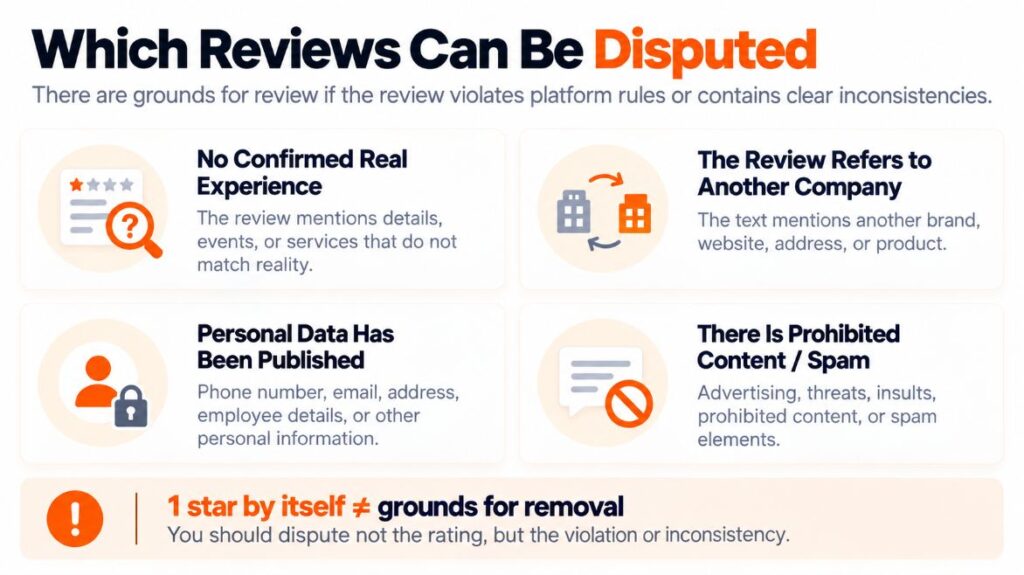
Which negative reviews can be disputed
Before filing a complaint, it is worth understanding whether there is a ground for moderation at all.
The review is not based on a real experience
One of the most frequent situations is that the company cannot determine who left the review.
But there is an important nuance here.
The absence of a person's name in the CRM does not yet prove that the review is fake. The user could write under a different name, interact with support, place an order without completing the purchase, or have another experience of communicating with the company.
It is much more important to look for factual inconsistencies.
For example:
- a product is mentioned that the company never sold;
- an office is described in a city where the company does not operate;
- a tariff is specified that did not exist;
- the date of the event does not coincide with the real dates;
- the described method of purchase is technically impossible.
The more such inconsistencies, the stronger the company's position.
The review is left about the wrong company
Sometimes a user really faced a problem, but posted the review on the page of another business.
This can be indicated by the name of another company, another website, service, address, or product.
If the mistake is obvious, it makes sense to dispute such a review.
Personal data is published in the review
A phone number, email, home address, employee data, and other personal information can become a separate ground for contacting moderation.
It is especially important not to duplicate this data in the company's public reply.
There is prohibited content in the text
Threats, some types of illegal content, advertising of third-party services, spam, and other violations can also be a ground for verification.
At the same time, harsh criticism in itself is not always a violation.
The phrase:
"This is the worst service I have ever used"
- is a subjective opinion.
And the statement:
"The company charged $5,000 from my card without permission"
- is already a specific statement about a fact that can be verified.
It is precisely such differences that matter when preparing a complaint.
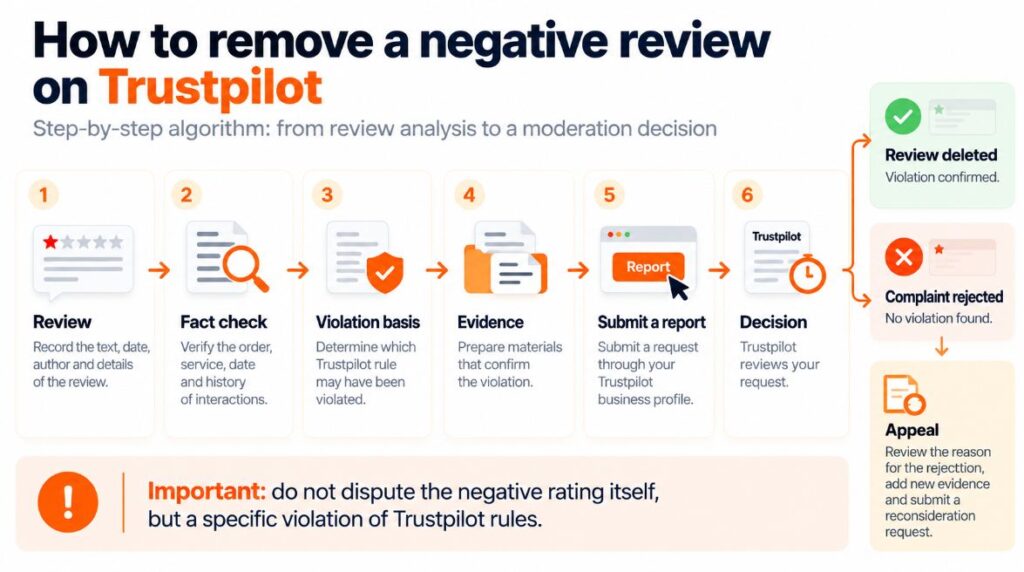
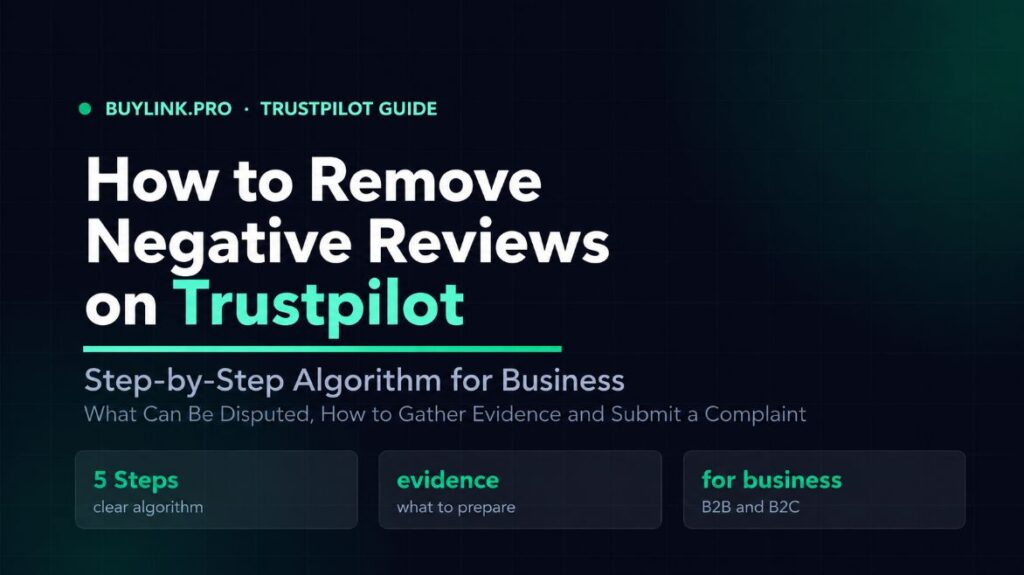
How to remove a negative review on Trustpilot: a step-by-step algorithm
Step 1. Record the review
You should not file a complaint in the first five minutes after discovering negativity.
First, save:
- the text of the review;
- the date of publication;
- the name or nickname of the user;
- the rating;
- the URL;
- a screenshot of the page;
- facts mentioned by the author.
If a person writes about a specific order, employee, delivery, payment, or refund - write this out separately.
After that, check the information against the CRM, orders, payments, and support requests.
The goal of the first stage is simple: to determine what actually happened.
Step 2. Find a specific violation
One of the main mistakes of a business is choosing the ground for a complaint based on the principle "which one looks more serious".
- The opposite approach works.
- The ground must correspond to the problem as accurately as possible.
- If the review refers to another company - prove exactly this.
- If personal data is published - indicate which data. If there are doubts about the reality of the experience - collect facts showing contradictions.
- The more accurately the problem is formulated, the clearer it is to the moderator.
Mass complaints without sufficient grounds do not increase the chances of removal. Moreover, Trustpilot separately warns about the inadmissibility of abusing the reporting system and can apply measures to the business profile - from restricting individual functions to a public warning.
Therefore, the strategy of "complain about all the negativity and see what gets removed" can create more problems than it solves.
Step 3. Try to identify the author
If it is unclear who left the review, Trustpilot allows you to request additional information from the user about their interaction with the company.
This can help to get a name, email, order number, or other data.
After such a request, Trustpilot gives the author three days to provide the requested information.
But it is important to understand:
if the user did not answer, the review does not disappear automatically.
A request for information is a verification tool, not a delete button.
Therefore, it is better to consider it together with other facts.
For example: the author did not provide data + there is no such order + the company does not provide the specified service.
Combined, this is already significantly more serious than a simple "we did not find the person in the database".
Step 4. Collect evidence
At this stage, the largest part of the result is decided.
It does not matter to moderation how much the review annoys the company. Verifiable facts are needed.
Compare the two wordings.
Weak:
This person was never our client and is deliberately writing lies.
Stronger:
The review states that service X was purchased on March 12. This service appeared at the company only on May 1 and was not sold before this date.
In the second case, there is a specific contradiction that can be verified.
As evidence, the following can be used:
- order data;
- request history;
- correspondence;
- product information;
- service launch dates;
- documents for payments or refunds;
- other materials relating to the specific situation.
The main rule is not the quantity of evidence, but their connection with the violation.
Two clear confirmations are often more useful than twenty random screenshots.
Step 5. File a complaint
After the analysis, you can proceed to dispute the review through the Trustpilot business profile.
There is no need to write a long history of the conflict.
A good complaint usually answers three questions:
- What is violated?
- Where exactly is this visible?
- How does the company confirm this?
After submission, Trustpilot checks the appeal and makes a decision.
The review itself may continue to be displayed, so working with it should not be put on pause.
Do you need to reply to the review while the verification is in progress?
In most cases - yes.
But the reply is needed not so much for the author of the negativity as for the people who will read the company's page later.
A potential client sees two sides at once:
- what the user wrote;
- how the business reacted.
Therefore, instead of:
You were never our client. Delete the false review.
it is better to write:
We could not identify the described situation based on the available information. We have requested additional data via Trustpilot and are ready to check the appeal in detail if the review is indeed related to interaction with our company.
Such an answer does not turn the page into a public quarrel and shows the future client that the business is in control of the situation.
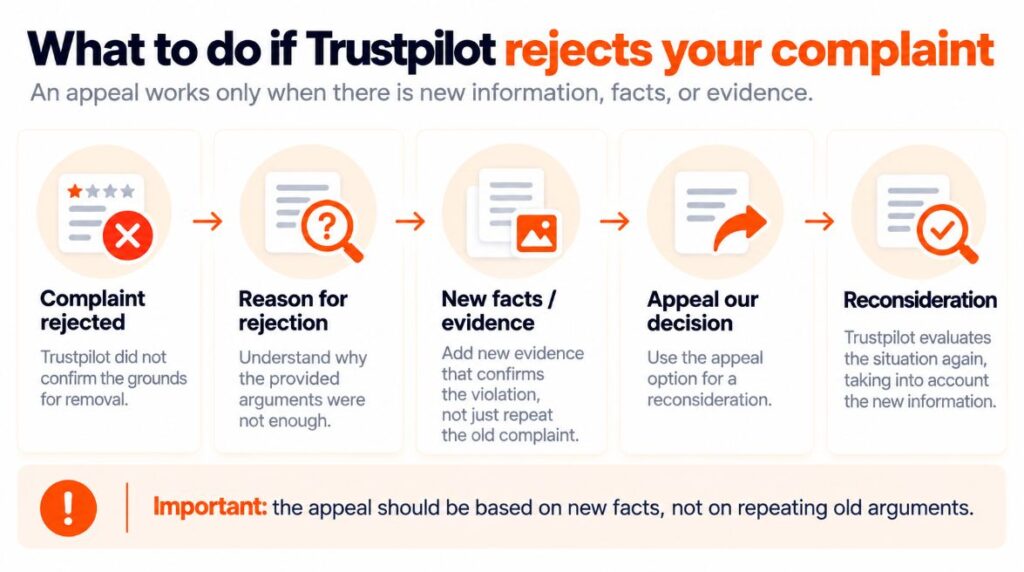
What to do if Trustpilot refused
A refusal to the first complaint does not always mean that further actions are meaningless.
First, you need to figure out why the arguments turned out to be insufficient.
If the company simply repeats the initial complaint in other words, the result is unlikely to change.
It is a different matter if new evidence has appeared.
For example:
- at first, the company only reported that it did not find the client;
- later it turned out that the review describes a service that was never provided at all.
This is already a new argument.
Since April 2026, Trustpilot has changed the procedure for appealing such decisions. It is no longer possible to reply directly to the email with the result of the check - the link Appeal our Decision is used for reconsideration.
Through it, the company can explain its position and attach additional supporting materials.
During an appeal, the logic should be the same:
- what decision was made;
- what the company disagrees with;
- what new fact confirms this;
- what evidence is attached.
Without emotions and long accusations.
The task of the appeal is not to tell once again why the review is unpleasant for the business, but to show moderation new information that can really influence the decision.
What you should not do for the sake of removing negativity
Some methods create more problems than the review itself.
It is especially dangerous to:
- complain about every negative review indiscriminately;
- send complaints about one review several times with different reasons;
- demand to remove real criticism just because of one star;
- threaten the author;
- disclose their data;
- offer money or a bonus for removal;
- buy positive reviews to quickly cover up the negativity.
The last option is especially risky.
Artificial five-star reviews can lead to problems with moderation and trust in the profile. As a result, an attempt to fix a single one-star rating is capable of creating a much more serious reputational problem.
And if the negative review is real?
Not every negative review needs to be removed.
If a client really faced a problem, and the review does not violate the rules, working with the conflict itself can become a more effective solution.
- Reply.
- Sort out the situation.
- Offer a normal solution.
- After settlement, the client himself can change or delete his review.
In parallel, it is worth building a systematic collection of reviews from real buyers. Not only from the most satisfied clients, but from the entire audience.
This way, the profile gradually begins to show the real picture of the business, and individual negativity ceases to determine the overall impression.
Why independent work often ends in refusal
At first glance, the process looks simple:
found a review → complained → waited for removal.
In practice, between the first and last point, many questions appear.
- Which rule is violated?
- Can the user be considered a real client?
- What evidence does moderation accept?
- What to do if the author does not reply?
- How to format a repeated appeal?
- When is it better not to file a complaint at all?
It becomes especially difficult if there are several negative reviews and each requires a separate strategy.
One can be disputed due to the lack of a real experience.
The second - due to personal data.
The third complies with the rules and should be handled through a public reply.
The fourth has already been disputed, so it is necessary to analyze the reason for refusal.
At this moment, working with Trustpilot turns from simple moderation into a full-fledged reputational process.
When is it better to hand over the work to specialists
With one obvious violation, a company can perfectly well try to figure it out on its own.
But if there are several negative reviews, complaints have already been rejected, or it is difficult to determine the right ground for disputing, it makes sense to consider professional work with Trustpilot.
This is especially relevant if:
- there are several negative reviews;
- complaints have already been rejected;
- it is difficult to determine the right ground;
- authors cannot be identified;
- serious accusations are present;
- Trustpilot affects sales and branded search;
- it is necessary to build constant work with reputation.
In such cases, it is more correct to start not with a promise to "delete everything", but with an audit of the reviews.
Usually, they can be divided into three categories:
1. There are grounds for removal.
You can prepare a complaint and an evidence base.
2. Grounds are possible, but there is not enough information.
First, you need to collect additional data.
3. There are no violations, or the probability of removal is low.
It is necessary to work through a reply, settlement of the situation, and the general reputation of the profile.
Such an approach allows you not to waste time on obviously weak appeals and focus on those reviews where there is a real chance to get a result.
Therefore, with several controversial publications, it is more reasonable to first conduct an audit of the profile: determine which reviews can really be disputed, which require an additional evidence base, and which are better handled through a reputational strategy.
This is especially important if Trustpilot is already appearing in branded Google search results and potential clients study the profile before making a purchase, registering, or signing a contract.
Removing a review is only part of the work with Trustpilot
Even if it was possible to remove a specific negativity, the problem can return in a week.
Therefore, for a business, not only the reaction to individual reviews is important, but also a system:
- monitoring of new publications;
- rapid analysis of negativity;
- a ready-made reply scenario;
- collection of real reviews;
- rating control;
- tracking Trustpilot in Google;
- regular audit of suspicious publications.
This allows you to work not when a one-star rating is already affecting deals, but much earlier.
Summary
It is possible to remove a negative review on Trustpilot, but a low rating or the company's disagreement with the author is not enough for this.
The main difficulty of working with Trustpilot is not how to send a complaint, but what complaint to file and what to back it up with.
It is precisely on the right ground, facts, and evidence that it depends whether a specific review has real prospects for removal.
Questions and Answers
What you need to know about removing and disputing negative reviews on Trustpilot.
Can a Trustpilot review be removed simply because it is false?
Simply calling a review false is not enough. You need to point out specific inconsistencies and provide evidence that allows the situation to be verified.
Will a review be removed if the company cannot find the author among its customers?
Not necessarily. The fact that a person cannot be found in the CRM does not, by itself, prove that they had no genuine experience with the company.
How much time does the reviewer have to respond to a request for information?
After a request for additional information is sent through Trustpilot, the reviewer has three days to provide the requested details. However, failing to respond does not automatically guarantee that the review will be removed.
What should you do if the reviewer does not respond to the information request?
Continue analyzing the review and gathering other supporting evidence. A lack of response can be one factor in the case, but it does not guarantee removal.
What should you do if Trustpilot rejects the complaint?
First, identify the reason for the rejection and check whether any additional facts or evidence have become available. If there are grounds for reconsideration, you can use the appeal process and submit new arguments.
Should you respond to a review if a complaint has already been submitted?
Yes, as long as the response is calm and professional. Potential customers may still see the review while Trustpilot is reviewing the complaint.
Can the removal of a negative review be guaranteed?
No. Trustpilot makes the final decision after reviewing the specific case. That is why it is important to assess the grounds and available evidence first, and only then choose the right strategy.