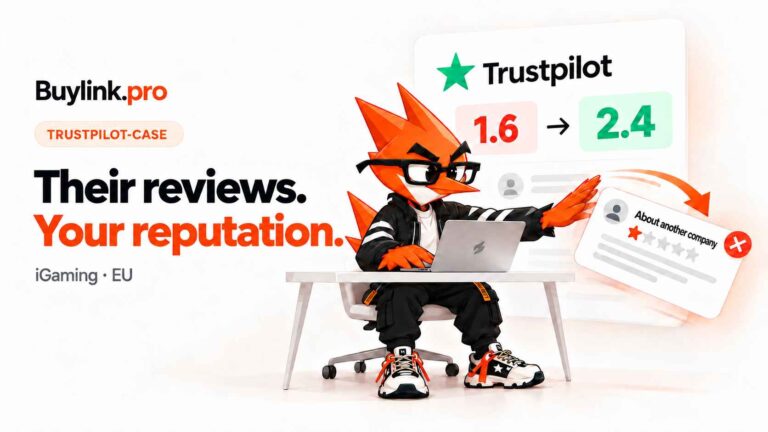
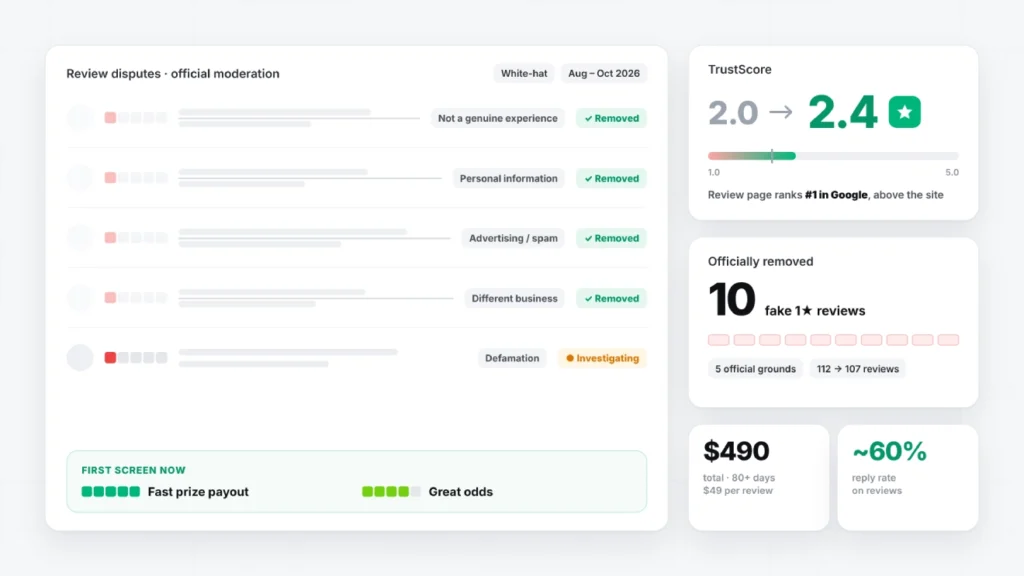
80+ days | Investments: $490 | Removed 10 reviews | Rating 2.0 → 2.4 | White-hat moderation
How Buylink.pro cleaned a social casino profile from unscrupulous negativity, disputed rule violations through the official Trustpilot arbitrage, and restored the conversion of the first screen in a highly competitive Tier-1 market.
Client and problem: Why is traffic not converting into players?
Inputs:
- Niche: iGaming.
- Region: Tier-1.
- Period: August - October 2026 (project in active work).
- Result: Official removal of 10 reviews, cleaning of the first screen from negative ratings, and rating growth from 2.0 to 2.4.
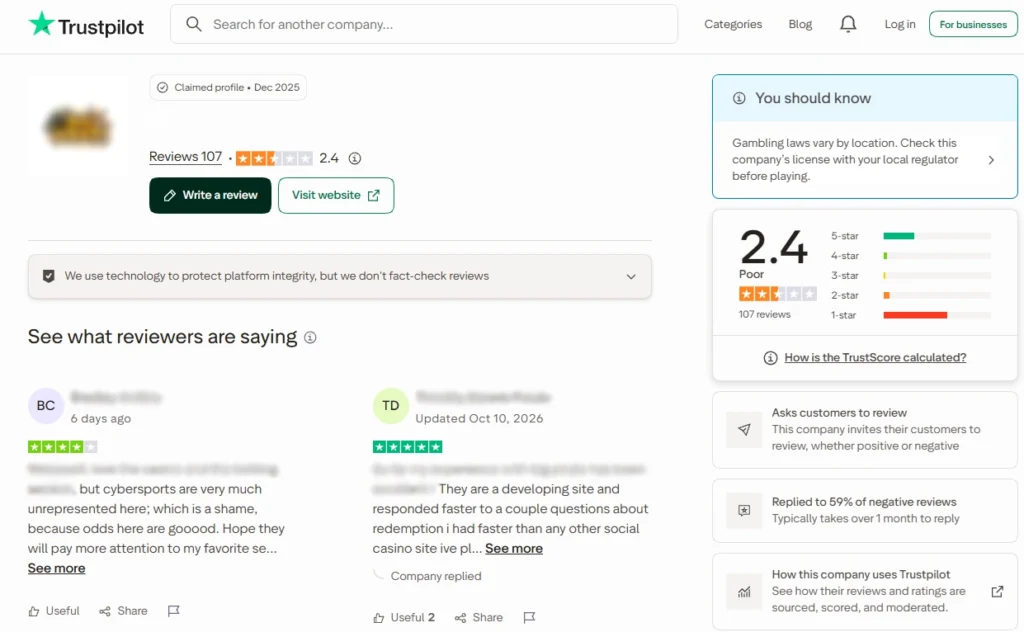
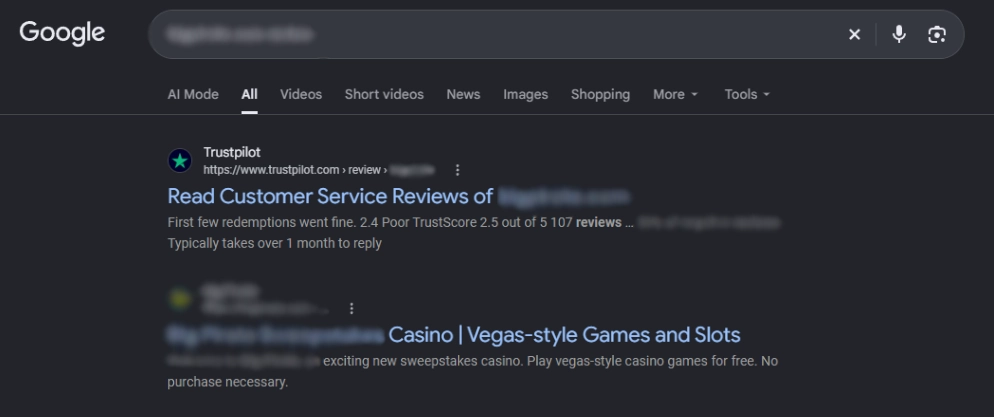
Situation: The platform is developing in the Social & Sweepstakes Casino segment popular in the US market. Marketing actively purchases expensive Tier-1 traffic, but at the stage of registration and purchasing starter packs, conversion drops sharply. The reason is on the surface: before starting the game, users type the brand name into Google, where on the first line (above the official website) stands the company's profile on Trustpilot.
What the problem was: At the start of work in August 2026, the profile rating fell to a critical mark of 2.0. The company did not engage in systematic collection of feedback from satisfied players, so the profile was formed chaotically. The entire first screen was occupied by fresh 1-star reviews: emotional accusations from players who did not pass the standard KYC verification procedure when withdrawing prizes, spam, unconstructive hate, and reviews disclosing personal data. This toxic background met every new user and blocked the desire to register.
How Buylink.pro developed a strategy
Instead of covering up negativity by purchasing dubious bots (which in Tier-1 markets quickly leads to a profile ban and a fraud badge from Trustpilot itself), we deployed a legal reputation protection protocol:
- Content audit: We analyzed the entire feed of negativity in detail for violations of the platform's internal rules. Many emotional 1-star comments contained direct violations that give the business a legal right to demand their complete removal.
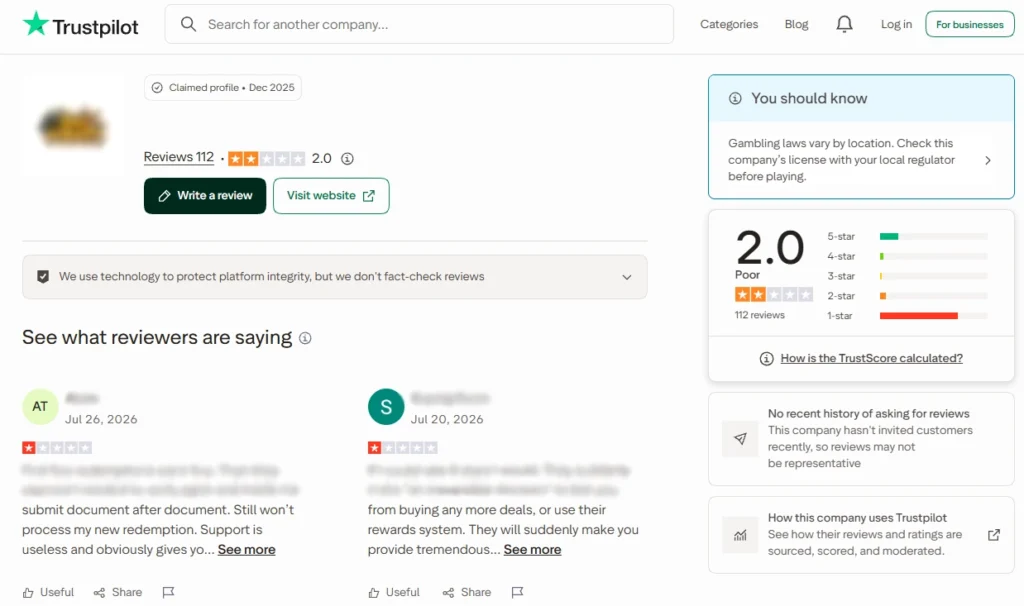
- Multi-vector disputing scenario: Unlike the template pressing of the "Report" button, we built individual argumentation for each problematic review, using 5 official grounds for removal at once:
- Not based on a genuine experience (The review is not based on a real customer experience / fake);
- Personal information (Disclosure of personal data of employees or internal support tickets);
- Advertising or promotional (Spam, promo codes, and advertising of third-party platforms);
- Harmful or illegal - Defamation (Direct slander and unsubstantiated accusations of fraud);
- About a different business (Claims to the wrong address).
What was done from August to October 2026
The work was built through the official business profile control panel, observing safe intervals for filing complaints to maintain high account trust before Trustpilot moderators.
- Period of work: 80+ days.
- Investments: $490.
- Moderation process: We initiated a phased disputing of negative reviews with a minimum rating. For reviews marked "Not based on a genuine experience", the system requested documentary confirmation of interaction with the platform from the authors. Since the authors of throw-ins and fakes could not provide real transaction IDs, the moderators took the side of the business.
- Evidence base: Reviews containing advertising links of competitors or personal data of support were removed directly after our reasoned tickets to the compliance service.
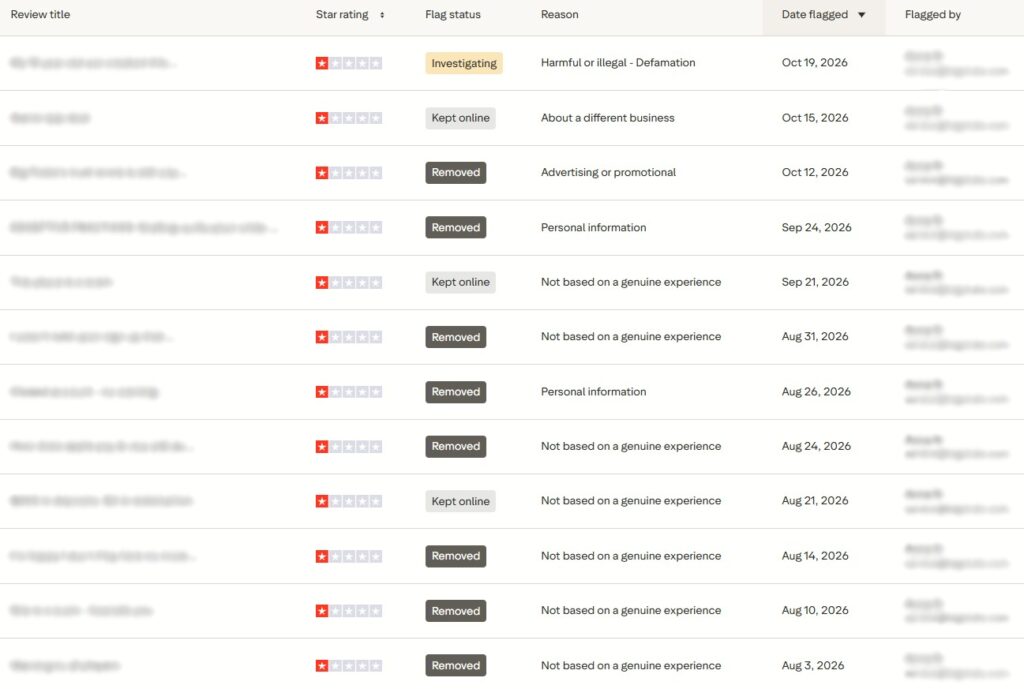
- Result: During the campaign, 10 critical 1-star reviews were officially removed (another series of complaints under the Defamation article is at the stage of investigation by moderators - status Investigating). The total number of reviews decreased from 112 to 107, and the platform's rating grew from 2.0 to 2.4.
Impact on the sales funnel
In addition to the mathematical growth of the rating, we solved the main visual problem of the profile - completely changed the picture of the first screen:
- Cleaning the entry point: By eliminating the flow of recent 1-star reviews, we freed up the upper part of the page. Now, coming from Google, players see real 4 and 5-star reviews on the first screen, praising high odds and fast prize payouts.
- Growth of support engagement: The profile received public markers of a live business - a mark of actively inviting clients to dialogue and a company response rate to reviews of almost 60%.
- Conversion restoration: When checking the brand in Google, potential players no longer face a stream of negative reviews. Eliminating this barrier allowed returning registration conversion indicators to planned values.
Project economics and payback
The mathematics of the project proves that targeted legal cleaning is one of the most cost-effective tools for protecting marketing:
- Investments in reputation cleaning: $490.
- Solution cost: $49 for one officially disputed and removed review.
- Cost of inaction: In the Tier-) market, the cost of acquiring one paying player in the Social & Sweepstakes Casino niche ranges from $50 to $150+. When a Trustpilot profile stands in 1st place in Google with a 2.0 rating and complaints about non-payments, the platform loses dozens of prepaid leads every week.
- Business result: The costs were compensated by retaining paid traffic that was previously lost after studying reviews. The company restored the effectiveness of marketing investments and prepared the profile for further increasing the average score.
For whom negativity removal works best
- For whom it is ideal: iGaming, Crypto & FinTech, Forex brokers, E-commerce, and SaaS platforms in Tier-1 and European markets. Companies whose rating suffers from fake competitor attacks, spam, slander, or inadequate user reactions to standard AML/KYC verification procedures.
- When we DO NOT recommend this channel: If the review is written by a real client who calmly, without insults, slander, and publication of personal data described their negative experience, and is ready to confirm it with receipts/screenshots to Trustpilot moderators. Such reviews are protected by the platform's rules - they need to be worked through via customer service and covered by systematic collection of positivity from a loyal base.
Evaluate the real losses of your funnel at the review verification stage
If your Trustpilot profile takes the first lines in Google for branded queries, but meets clients with a rating below 3.5 and complaints on the first screen - you are daily financing your competitors.
Leave a request for an audit and get a Trustpilot Legal Map for your business.
As part of the audit we will:
- Conduct a revision of all 1 and 2-star reviews in your profile for violations of Trustpilot rules.
- Tell you exactly what percentage of negativity can be officially removed through the platform's arbitrage.
- Form a safe step-by-step disputing plan without the risk of blocks from moderation.
- Calculate the exact cost of cleaning and show how to raise the overall TrustScore of your brand.
How we manage such projects and how much it costs is described on the page reputation management on Trustpilot.